EU AI Act

Rani Alhamss
Co-founder
April 9, 2026
Did the phrase AI act cross your path before?
AI act is the world’s first law regulating AI, the goal of AI act is to ensure that the AI is used responsibly. The rules place responsibilities on those who create and use AI and control how AI systems are approved in the EU single market.
The law deals with risks related to AI, such as bias, discrimination, and lack of accountability, while also promoting innovation and encouraging the use of AI. AI act might become the EU’s rules could become a global model, much like the GDPR did for data protection, helping to ensure AI is ethical, safe, and reliable around the world.
What kind of risks does AI impose ?
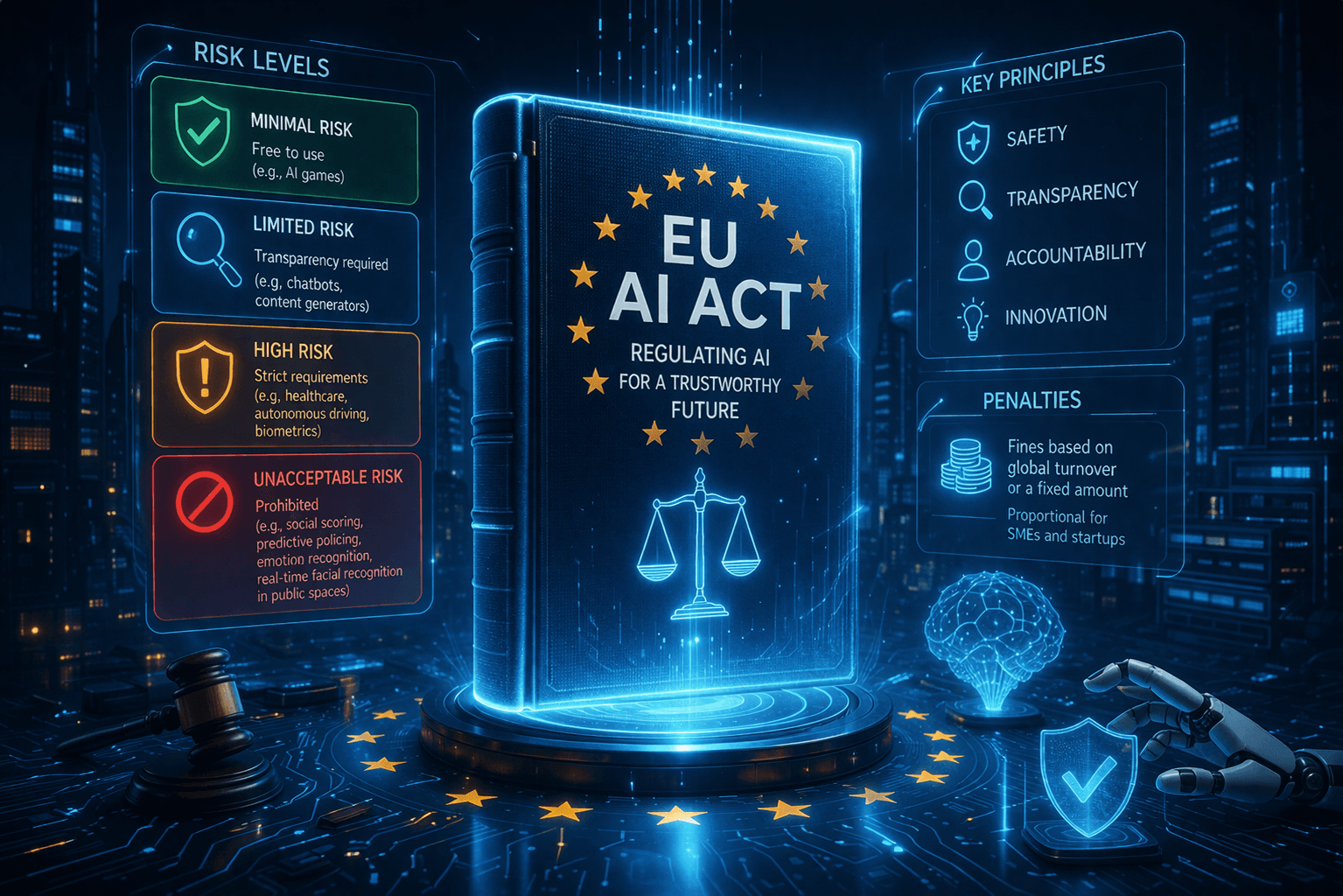
The AI Act classifies AI uses into four risk levels and sets different rules depending on the level of risk. Minimal: such as AI-powered games, they can be used freely and the EU AI act does not affect them.
Limited: AI systems with limited risk, like chatbots or content-generating tools, must follow transparency rules. This means users should be told when content is produced by AI so they can decide how to use it.
High: AI systems considered high-risk, such as those used for disease diagnosis, self-driving cars, and biometric identification in criminal cases, must follow strict rules to access the EU market. These rules include careful testing, transparency, and human supervision.
Unacceptable:AI systems that threaten individuals’ safety, rights, or livelihoods are prohibited in the EU. These include practices such as cognitive behavioural manipulation, predictive policing, emotion recognition in workplaces and educational settings, and social scoring. The use of real-time remote biometric identification, including facial recognition by law enforcement in public spaces, is also banned, except in limited circumstances.
Penalties: The law introduces fines for breaking the rules. The penalties are based on either a percentage of the company’s worldwide turnover from the previous year or a fixed sum, depending on which is higher. SMEs and start-ups receive proportional fines.
Impact and Future Outlook:
The EU AI Act is not only shaping the legal landscape for AI in Europe but also influencing AI development globally. By setting clear standards for safety, transparency, and accountability, it encourages companies to design AI responsibly from the start. Many experts believe that technology providers outside the EU may adopt similar practices to access the European market, potentially making the AI Act a global benchmark. Additionally, the law is expected to foster public trust in AI, promoting wider adoption of innovative technologies while ensuring that ethical considerations remain central to AI deployment.
Sources:
https://www.consilium.europa.eu/en/policies/artificial-intelligence-act/?utm_source=chatgpt.com#0
https://digital-strategy.ec.europa.eu/en/policies/regulatory-framework-ai?utm_source=chatgpt.com
Ready to secure your intelligence?
Contact us to discuss your specific requirements and how we can help you implement secure on-premise AI solutions.
Contact Information
Phone
+46 123 456 789
info@onprio.com
Address
123 Business Street