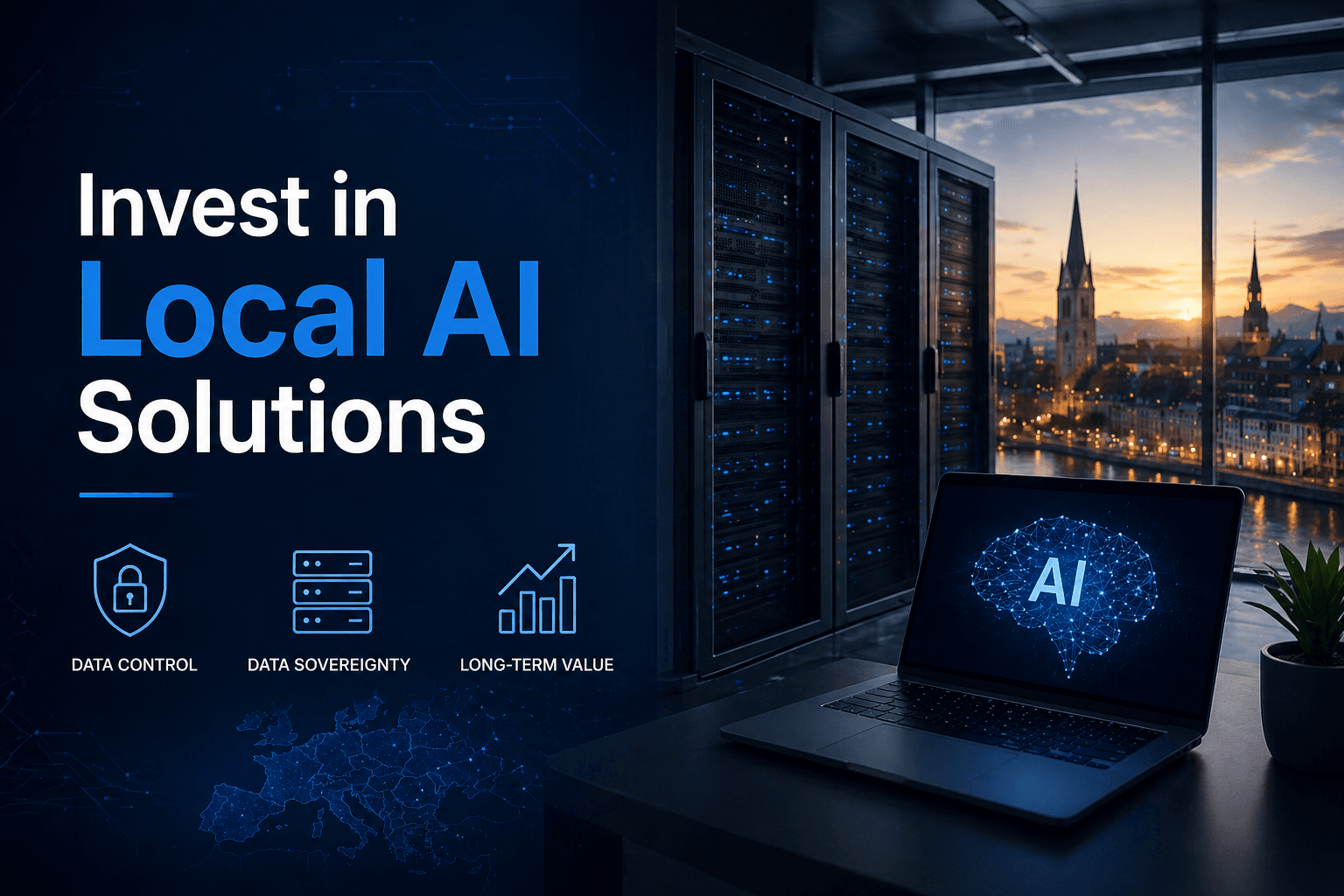
When Should Companies Invest in Local AI Solutions?

Rani Alhamss
Co-founder
April 30, 2026
When Should Companies Invest in Local AI Solutions?
The Decision Is Strategic—Not Technical
The common question—build or buy AI—misses the point. The real issue is where AI creates competitive advantage and where it simply supports operations.
Local AI solutions become relevant when AI is closely tied to how a company differentiates itself or handles sensitive information. In those cases, control matters more than convenience. If AI is only used for generic tasks, external tools are often sufficient. But when it becomes part of the core business, relying entirely on third parties introduces long-term risk.
Short-Term Convenience vs Long-Term Efficiency
Cloud-based AI is attractive because it is fast to deploy and requires little upfront investment. For many companies, this makes it the obvious starting point.
However, this cost advantage often erodes over time. As usage increases, so do API and licensing costs. What initially feels flexible can turn into a growing operational expense.
Local AI, on the other hand, demands more initial investment but offers better cost control in the long run. Once deployed, it removes recurring fees and allows systems to be tailored more precisely to internal needs.
Data Control and Regulation
For companies operating in Europe, data is often the deciding factor. Frameworks like the General Data Protection Regulation and the EU AI Act emphasize accountability in how data is stored, processed, and used.
Local AI provides clear advantages:
- Data stays within the organization
- Compliance and auditability are easier to manage
- Risks of sensitive data exposure are reduced
With external AI providers, data often flows through third-party infrastructure, making control and compliance more complex. Over time, this can turn critical business data into a dependency rather than an asset.
The Hidden Risk of Vendor Lock-In
Vendor lock-in rarely appears at the start—it builds gradually. Companies begin by integrating APIs, then adapt workflows, and eventually rely on specific models and pricing structures.
As dependence increases, flexibility decreases. Switching providers becomes costly, both technically and operationally.
Local AI reduces this risk by keeping control over infrastructure and development in-house, allowing companies to evolve their systems without being tied to external constraints.
When Local AI Makes Sense
Investing in local AI is justified when:
- AI is part of the core product or service
- The company relies on proprietary or sensitive data
- Systems require deep internal integration
- Regulatory requirements are strict
In these situations, AI is no longer just a tool—it becomes a strategic capability. Control over data, models, and infrastructure is essential.
A Balanced Approach
For most organizations, the optimal strategy is not choosing one over the other.
External AI solutions are well-suited for standard, low-risk tasks, while local AI should be reserved for areas that drive differentiation or involve sensitive data. This hybrid approach allows companies to move quickly without sacrificing long-term control.
Sources
European Commission – GDPR Overview: https://commission.europa.eu/law/law-topic/data-protection_en
European Commission – EU AI Act: https://digital-strategy.ec.europa.eu/en/policies/european-approach-artificial-intelligence
Ready to secure your intelligence?
Contact us to discuss your specific requirements and how we can help you implement secure on-premise AI solutions.
Contact Information
Phone
+46 123 456 789
info@onprio.com
Address
123 Business Street